


Discover the Academic Programs of FDCHT BINUS University: From Insight to Impact for a Sustainable Future
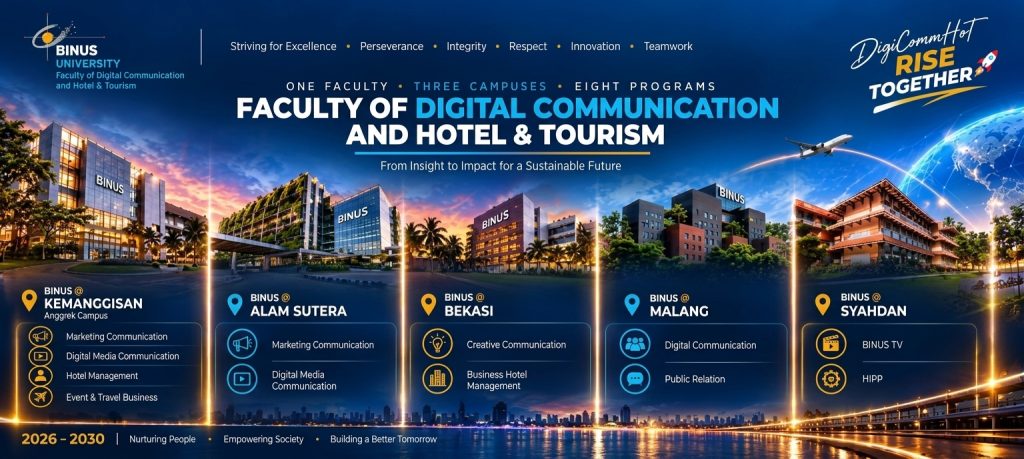
The Faculty of Digital Communication and Hotel & Tourism (FDCHT) at BINUS University brings together diverse academic disciplines that shape how people communicate, create content, build relationships, deliver memorable experiences, and connect with the world.
Guided by the vision of From Insight to Impact for a Sustainable Future, FDCHT fosters an educational environment where creativity, digital innovation, business knowledge, and professional competencies come together. Across its campuses, students have opportunities to explore their interests, develop practical skills, and prepare for the evolving demands of the communication, media, hospitality, and tourism industries.
With a shared commitment to striving for excellence, perseverance, integrity, respect, innovation, and teamwork, each academic program contributes to the faculty’s broader mission of nurturing people, empowering society, and building a better tomorrow.
1. Marketing Communication
Campus: Kemanggisan and Alam Sutera
Marketing Communication explores how organizations build meaningful relationships with their audiences through strategic messaging, branding, advertising, public engagement, and integrated marketing campaigns.
Students develop an understanding of consumer behavior, brand positioning, communication planning, and creative campaign development. By combining strategic thinking with creativity and digital awareness, the program prepares students to communicate brand values effectively across different platforms and audience segments.
Graduates can pursue opportunities in advertising agencies, brand management, marketing strategy, corporate communication, campaign planning, and integrated marketing communication.
2. Digital Media Communication
Campus: Kemanggisan and Alam Sutera
Digital Media Communication focuses on the evolving relationship between communication, digital platforms, content creation, and audience engagement. As media consumption continues to change, organizations increasingly need professionals who can create compelling content and communicate effectively in a connected digital environment.
Students explore digital storytelling, multimedia content development, social media communication, and the strategic use of digital platforms. The program encourages them to combine creative expression with an understanding of audiences, emerging technologies, and contemporary media trends.
Career opportunities may include digital content creation, social media strategy, multimedia production, digital campaign development, and creative communication.
3. Hotel Management
Campus: Kemanggisan
Hotel Management prepares students to understand the operational, managerial, and service dimensions of the hospitality industry. With a focus on guest experiences and professional service standards, the field connects hospitality knowledge with business management and the practical realities of hotel operations.
Students develop an understanding of hospitality operations, customer service, teamwork, problem-solving, and service quality. Through the application of management principles and practical learning, they gain insights into how hospitality businesses create value and deliver memorable guest experiences.
Graduates can explore careers in hotel operations, front office management, food and beverage operations, rooms division, hospitality entrepreneurship, and other accommodation or service-related businesses.
4. Event & Travel Business
Campus: Kemanggisan
Event & Travel Business explores the business opportunities behind events, travel experiences, destination activities, and tourism-related services. The field combines planning, coordination, customer experience, business development, and destination knowledge to create meaningful experiences for different audiences.
Students develop an understanding of event planning, travel business operations, experience development, service coordination, and the commercial aspects of the visitor economy. They are encouraged to approach events and travel not only as activities but also as opportunities to create social, cultural, and economic value.
Potential career pathways include event management, travel consultancy, tour operations, destination services, corporate events, and tourism entrepreneurship.
5. Creative Communication
Campus: Bekasi
Creative Communication emphasizes the development of innovative ideas and compelling messages that connect organizations with their audiences. It brings together creative thinking, communication strategy, storytelling, and contemporary approaches to engaging people across different contexts.
Students are encouraged to explore how ideas can be transformed into meaningful communication through creative concepts, audience insights, and effective message development. The field supports the development of adaptable professionals who can respond to changing communication needs and contribute fresh perspectives to organizations and creative industries.
Career opportunities may include creative strategy, advertising, content development, communication planning, campaign ideation, and creative project management.
6. Business Hotel Management
Campus: Bekasi
Business Hotel Management combines hospitality perspectives with business-oriented thinking to help students understand how hotel and accommodation businesses operate, compete, and grow.
The field connects service management with business strategy, operational efficiency, customer experience, and organizational development. Students are encouraged to understand both the guest-facing and business-facing dimensions of hospitality, including how effective management decisions can support service quality and sustainable business performance.
Graduates may pursue careers in hotel operations, hospitality business development, hotel administration, revenue-related functions, guest experience management, and hospitality entrepreneurship.
7. Digital Communication
Campus: Malang
Digital Communication examines how individuals, organizations, and communities communicate in an increasingly technology-driven world. It focuses on the changing ways information is produced, distributed, interpreted, and experienced across digital channels.
Students explore contemporary communication practices, digital platforms, audience engagement, and the role of technology in shaping communication strategies. The field encourages students to think critically about digital environments while developing the creative and analytical skills needed to communicate effectively.
Potential career pathways include digital communication strategy, digital campaign management, online content development, social media communication, and digital engagement.
8. Public Relation
Campus: Malang
Public Relations focuses on building and maintaining positive relationships between organizations and their stakeholders. It plays an important role in developing organizational credibility, managing public perception, communicating key messages, and strengthening trust.
Students explore strategic communication, stakeholder engagement, media relations, reputation management, and organizational communication. The field emphasizes the importance of clear messaging, ethical communication, and the ability to respond thoughtfully to changing public expectations.
Graduates may pursue careers in public relations agencies, corporate communication, media relations, reputation management, stakeholder engagement, and communication consulting.
9. BINUS TV
Campus: Syahdan
BINUS TV represents a media-oriented learning and production environment that connects communication knowledge with audiovisual storytelling and broadcasting-related activities.
Through exposure to media production and content development, students can gain insights into how stories are planned, produced, and communicated to audiences. The platform also reflects the importance of creativity, collaboration, technical execution, and responsible storytelling in today’s evolving media landscape.
Experiences associated with television and media production can support future pathways in audiovisual production, broadcasting, video content creation, production coordination, and multimedia communication.
One Faculty, Shared Values, and a Sustainable Future
Although each program has its own academic focus, all FDCHT programs share a broader commitment to developing capable, creative, and responsible individuals.
The faculty’s educational direction emphasizes six core values: striving for excellence, perseverance, integrity, respect, innovation, and teamwork. These values provide a common foundation for students as they develop professional competencies, explore new ideas, and prepare to contribute to their chosen industries.
Across digital communication, media, hospitality, and tourism, the ability to understand people, embrace innovation, collaborate effectively, and respond to change remains essential. FDCHT encourages students to connect their academic knowledge with real-world opportunities and consider how their work can create positive and lasting impact.
From insight to impact, FDCHT BINUS University empowers students to turn knowledge into meaningful experiences, ideas into opportunities, and ambition into contributions toward a more sustainable future.
Comments :